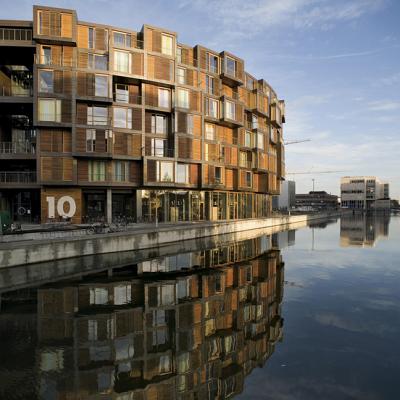
The global resources situation and the climate crisis are amongst the biggest challenges faced by mankind today. In the years to come, these issues will no doubt have an influence on societal evolution, on urban and rural land development, and how we define our cultural identities. These and related issues will be reflected in the world of architecture. In recent years many countries with high energy consumption have made the energy-related requirements for buildings more stringent; the new rules apply to the resources used for construction as well as to those used in the operation of buildings. In the future, these new requirements will have a major impact on the design of buildings. It will not be sufficient merely to increase the insulation thickness or to make the building envelope more airtight. Solutions of this type have an adverse impact on the architectural design, on the construction practices, on the indoor environment and on options for making buildings flexible so that they can be adapted for diverse uses over time. Equally important in terms of its impact on architectural quality is the challenge posed by the continuous growth of industrialisation. The move from craft-based construction methods to computer-controlled production processes now used in industrialised manufacturing has resulted in strict standards, established at design level, being imposed on the process as it takes place on the building site, creating an "assembly architecture" that no longer depends on the locally available materials, on local cultural traditions or on the specific physical context. In this book, ideas, design principles and practices that relate to tectonics in architecture are explored, and a series of themes are discussed in relation to various concepts of ecology. Ecology is, in this case, defined in its widest sense, which includes the cycling of resources, systems of social organisation and the environmental context. Tectonics a concept with a long tradition in architecture and architectural theory is comparable to ecology. It relates to the de-sign and assembly of structural elements, and implies a holistic approach to materials, to construction technology and to the design of structures. It is more than merely an instrumental strategy: it extends into the poetic, which elevates it to the status of a cultural practice. This book is part of a research project conducted by leading academics associated with the Royal Danish Academy of Fine Arts School of Architecture, the Aarhus School of Architecture and the Danish Building Research Institute. With contributions from a wider network of academic experts and from practicing architects, it provides the first comprehensive representation of contemporary tectonic thought and practices in architecture.
The global resources situation and the climate crisis are amongst the biggest challenges faced by mankind today. In the years to come, these issues will no doubt have an influence on societal evolution, on urban and rural land development, and how we define our cultural identities. These and related issues will be reflected in the world of architecture. In recent years many countries with high energy consumption have made the energy-related requirements for buildings more stringent; the new rules apply to the resources used for construction as well as to those used in the operation of buildings. In the future, these new requirements will have a major impact on the design of buildings. It will not be sufficient merely to increase the insulation thickness or to make the building envelope more airtight. Solutions of this type have an adverse impact on the architectural design, on the construction practices, on the indoor environment and on options for making buildings flexible so that they can be adapted for diverse uses over time.
Equally important in terms of its impact on architectural quality is the challenge posed by the continuous growth of industrialisation. The move from craft-based construction methods to computer-controlled production processes now used in industrialised manufacturing has resulted in strict standards, established at design level, being imposed on the process as it takes place on the building site, creating an "assembly architecture" that no longer depends on the locally available materials, on local cultural traditions or on the specific physical context.
In this book, ideas, design principles and practices that relate to tectonics in architecture are explored, and a series of themes are discussed in relation to various concepts of ecology. Ecology is, in this case, defined in its widest sense, which includes the cycling of resources, systems of social organisation and the environmental context. Tectonics—a concept with a long tradition in architecture and architectural theory—is comparable to ecology. It relates to the design and assembly of structural elements, and implies a holistic approach to materials, to construction technology and to the design of structures. It is more than merely an instrumental strategy: it extends into the poetic, which elevates it to the status of a cultural practice.
This book is part of a research project conducted by leading academics associated with the Royal Danish Academy of Fine Arts School of Architecture, the Aarhus School of Architecture and the Danish Building Research Institute. With contributions from a wider network of academic experts and from practicing architects, it provides the first comprehensive representation of contemporary tectonic thought and practices in architecture, tonic thinking and practice in architecture.
The global resources situation and the climate crisis are amongst the biggest challenges faced by mankind today. In the years to come, these issues will no doubt have an influence on societal evolution, on urban and rural land development, and how we define our cultural identities. These and related issues will be reflected in the world of architecture. In recent years many countries with high energy consumption have made the energy-related requirements for buildings more stringent; the new rules apply to the resources used for construction as well as to those used in the operation of buildings. In the future, these new requirements will have a major impact on the design of buildings. It will not be sufficient merely to increase the insulation thickness or to make the building envelope more airtight. Solutions of this type have an adverse impact on the architectural design, on the construction practices, on the indoor environment and on options for making buildings flexible so that they can be adapted for diverse uses over time. Equally important in terms of its impact on architectural quality is the challenge posed by the continuous growth of industrialisation. The move from craft-based construction methods to computer-controlled production processes now used in industrialised manufacturing has resulted in strict standards, established at design level, being imposed on the process as it takes place on the building site, creating an "assembly architecture" that no longer depends on the locally available materials, on local cultural traditions or on the specific physical context. In this book, ideas, design principles and practices that relate to tectonics in architecture are explored, and a series of themes are discussed in relation to various concepts of ecology. Ecology is, in this case, defined in its widest sense, which includes the cycling of resources, systems of social organisation and the environmental context. Tectonics a concept with a long tradition in architecture and architectural theory is comparable to ecology. It relates to the de-sign and assembly of structural elements, and implies a holistic approach to materials, to construction technology and to the design of structures. It is more than merely an instrumental strategy: it extends into the poetic, which elevates it to the status of a cultural practice. This book is part of a research project conducted by leading academics associated with the Royal Danish Academy of Fine Arts School of Architecture, the Aarhus School of Architecture and the Danish Building Research Institute. With contributions from a wider network of academic experts and from practicing architects, it provides the first comprehensive representation of contemporary tectonic thought and practices in architecture.
Get Towards an Ecology of Tectonics by at the best price and quality guranteed only at Werezi Africa largest book ecommerce store. The book was published by Edition Axel Menges and it has pages. Enjoy Shopping Best Offers & Deals on books Online from Werezi - Receive at your doorstep - Fast Delivery - Secure mode of Payment