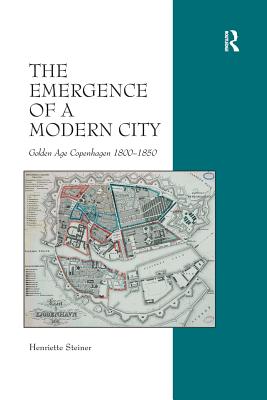
During Denmarks Golden Age (c. 1800 to 1850), Copenhagen came into being as a modern city on the urban-cultural level. This book examines this period in the citys history, just before the establishment of some of the main features of the modernisation of cities associated with industrialisation, such as street lighting, sewer systems, and working class quarters. It assesses the work of the most prominent architect of the period, C.F. Hansen, in transforming the city physically, before moving on to consider writings by three citizens of Copenhagen, the philosopher Soren Kierkegaard, the novelist Thomasine Gyllembourg and the criminal Ole Kollerod, all of whom write about the citys institutional structure and urban life.
This book is an exploration of how urban life in Copenhagen, in the period known as the Golden Age (c. 1800 to 1850), was experienced and structured socially, institutionally, and architecturally. It draws on a broad historical source material - spanning urban anecdotes, biography, philosophy, literature, and visual culture - to do so. The book argues that Copenhagen emerged as a modern city at this time, despite the fact that the Golden Age never witnessed the appearance of the main characteristics of the modernisation of cities associated with industrialisation, such as street lighting, sewer systems, and railroads. The book outlines the historical and topographical context of Copenhagen in the Golden Age with a special focus on the works of the most prominent architect of the period, C.F. Hansen. The characterisation of the city is complemented by investigations into writings of three citizens: the philosopher Soren Kierkegaard, the novelist Thomasine Gyllembourg, and the criminal Ole Kollerod, who all take an interest in the city''s institutional and urban structures as well as their own place in it. From these different sources, a picture is painted of urban life and thought at a time when the city began to take on characteristics of ambiguity and alienation in European thinking, while at the same time the city itself retained some pre-modern motifs of a symbolic order. This transformation is set in a larger process of cultural re-orientation, from traditional Baroque culture to what might be termed Romantic culture. The book reconsiders the significance of this transformation for the emergent order of the modern European city in the nineteenth century and thus of the very foundation on which our own urban culture rests.
Get The Emergence of a Modern City by at the best price and quality guranteed only at Werezi Africa largest book ecommerce store. The book was published by Taylor & Francis Ltd and it has pages. Enjoy Shopping Best Offers & Deals on books Online from Werezi - Receive at your doorstep - Fast Delivery - Secure mode of Payment