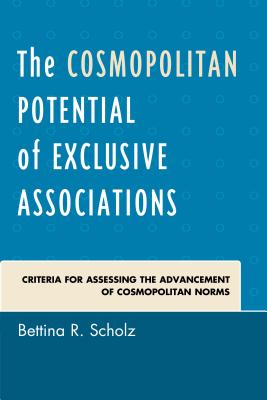
This book assesses the extent to which transnational non-state associations help to cultivate greater respect for the moral equality of all humans and to build transnational communities. It shows that such cosmopolitan ideals can arise from unexpected places in our world without the self-conscious intention of advancing a common human community.
Contemporary cosmopolitan moral theorists argue that, in our increasingly interconnected world, all individuals need to recognize that moral duties span state borders, involving responsibilities such as respecting human rights. Such arguments usually focus on the duties of individuals or on reforms for international political and economic institutions. The Cosmopolitan Potential of Exclusive Associations draws attention to how non-state, not-for-profit transnational associations can advance respect for equality in a plurality of less obvious ways. By synthesizing moral theories of cosmopolitanism with international relations scholarship, it is possible to establish criteria for assessing whether and to what extent transnational associations like Médecins sans Frontières (Doctors without Borders) or the International Olympic Committee cultivate respect for fellow humans and build transnational communities. As these examples show, not all non-state associations have the mission of advocating for human rights. Membership is also not necessarily inclusive of all humanity. Membership criteria exclude based on criteria such as professional expertise, athletic prowess, or certain religious beliefs. As a result, assessing their impact requires looking for partial expressions of cosmopolitanism that arise piecemeal and without self-conscious intention. Rather than defending one version of cosmopolitan theory as more applicable to evaluating the impact of associations, adapting and combining four common approaches to cosmopolitanism—(1) institutional cosmopolitanism, (2) natural duties cosmopolitanism, (3) cultural cosmopolitanism, and (4) deliberative democratic cosmopolitanism—makes it possible to evaluate institutional, developmental, shared-identity, or public-sphere effects of associations. Applying the criteria to associations that do not self-consciously advance cosmopolitanism shows the potential for partial forms of cosmopolitanism. Médecins sans Frontières, the first case explored, provides emergency medical care across the globe without establishing a transnational community with those it aids. The International Olympic Committee, the second case, brings the world together around global games in which national teams compete against each other. Dissidents in the Anglican Communion, the third case, unite across borders but do so in favor of an interpretation of the Bible that excludes gay men from ordained ministry. Despite non-cosmopolitan elements, each case has lessons about how respect for transnational equality can emerge in subtle ways without self-conscious belief in cosmopolitan moral philosophy.
Get The Cosmopolitan Potential of Exclusive Associations by at the best price and quality guranteed only at Werezi Africa largest book ecommerce store. The book was published by Bloomsbury Publishing Plc and it has pages. Enjoy Shopping Best Offers & Deals on books Online from Werezi - Receive at your doorstep - Fast Delivery - Secure mode of Payment